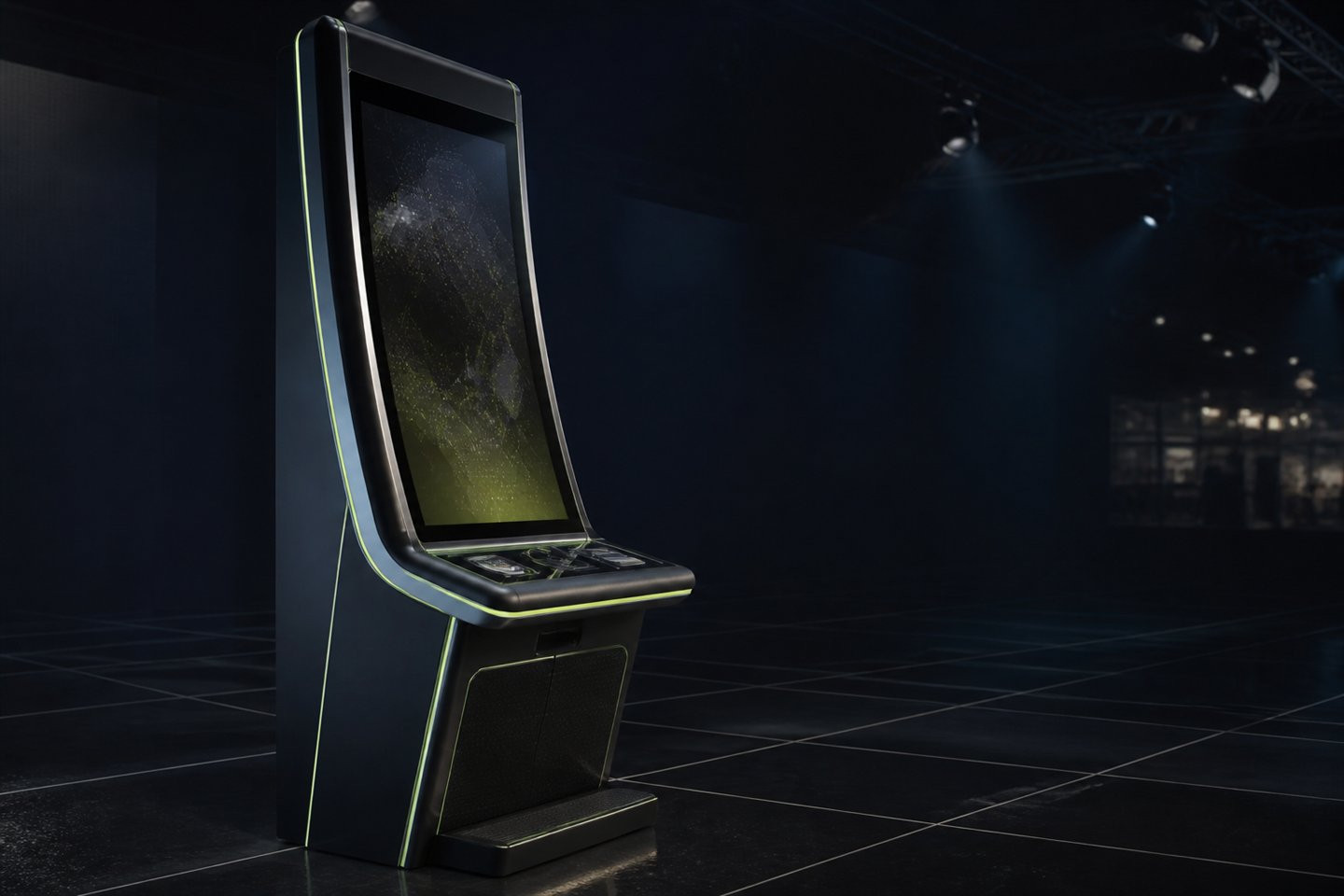
Casino hardware launches often arrive as lists of dimensions and lighting features. On 10 August, Aristocrat Gaming introduced Reign, a cabinet built around a custom curved 52-inch 4K touchscreen, multi-colour game-driven edge lighting, revised sightlines, wireless charging and the manufacturer’s Gen10 platform. Deployment has started in North America, with a G2E appearance scheduled for September.
Those specifications matter, but they do not explain the investment decision. A cabinet is a physical endpoint in a larger operating system. It has to host content, run reliably, fit existing floor plans, support technicians, satisfy regulators, coexist with player-account tools and retain visual relevance for years. That is why the platform beneath the display can be more strategically important than the display itself.
Manufacturer-disclosed Reign details
- Custom curved 52-inch 4K touchscreen monitor.
- Game-driven multi-colour LED edge lighting.
- Improved sightlines and player ergonomics.
- Wireless device charging.
- Gen10 operating platform.
- North American deployment underway; G2E 2026 display planned.
Elvari Scope has not independently laboratory-tested the cabinet. Specifications are attributed to Aristocrat’s announcement.
Screen size is now table stakes
Large-format screens have become familiar on premium casino floors. Their value is not simply spectacle. Curvature, pixel density, viewing distance and interface layout affect how quickly a player can understand information. For an operator, the cabinet’s footprint and height influence visibility across a bank and through adjacent zones.
A taller or brighter cabinet can win attention locally while damaging the floor globally if it blocks sightlines or overwhelms nearby products. Aristocrat’s emphasis on sightlines therefore deserves attention. It suggests the cabinet is being sold not only as an isolated object but as a component in a planned environment.
Touchscreen geometry also changes content design. Developers must account for hand reach, button scale, information hierarchy and accessibility across a large vertical surface. A game designed for an older button-deck format cannot always be expanded without rethinking interaction.
The platform is the longer bet
Aristocrat says Reign runs on Gen10. A new processing platform can increase the headroom available to game studios, support richer audio-visual presentation and standardise future content development. It can also simplify the supplier’s product line if tools and deployment processes converge around a common architecture.
For operators, platform continuity affects how quickly content can be certified, installed and rotated. It affects spare parts, technician training, system integration and the useful life of the asset. The strongest platform story is therefore operational: predictable maintenance and a credible future content pipeline.
The modern cabinet is simultaneously furniture, regulated device, network endpoint, accessibility interface and content platform. Judging it on the monitor alone misses most of the cost.
Ergonomics becomes measurable
Cabinet ergonomics should be evaluated across more than the seated player’s first impression. Operators need to consider reach range, glare, audio spill, wheelchair access, foot clearance, privacy, cleaning and the ease with which staff can inspect or service components. Small hardware choices repeat across hundreds or thousands of operating hours.
Wireless charging is a minor line in a product announcement, but it reflects a broader design direction: cabinets are expected to accommodate the devices people bring with them. That convenience also introduces questions around heat, durability, foreign objects and service replacement. A feature earns its place only when it remains reliable on a busy floor.
A launch is the beginning of the evidence cycle
The North American rollout should generate the information procurement teams actually need: performance by location, fault rates, content mix, player dwell, service time and the way cabinets work in different bank configurations. Trade-show response can validate visibility and design, but it cannot substitute for live operating evidence.
G2E will provide an opportunity to see how Reign sits alongside other cabinet families and how Aristocrat connects the hardware to new game titles. The most useful operator conversations will likely focus on installation pathways, backwards or cross-platform content support, maintenance access and the deployment cadence by jurisdiction.
What this signals for manufacturers
- Hardware and content road maps are converging. A cabinet needs launch titles, but it also needs a visible multi-year pipeline.
- Floor planning is part of the pitch. Sightlines, bank geometry and lighting integration help operators justify the placement.
- Service design can differentiate. Downtime and technician minutes are operating costs, even when they never appear in the brochure.
- Compute headroom matters. Studios need enough platform capability to evolve without forcing an early cabinet replacement.
- Compliance is part of product quality. Logging, configuration control and predictable jurisdictional builds reduce deployment friction.
Reign is one product announcement, not a verdict on the whole hardware market. Yet it captures the direction of travel. The cabinet is becoming less like a fixed terminal and more like a managed physical platform whose value is realised across content, systems and the floor around it.
Disclosure: Elvari Scope received no payment or equipment for this report and has no affiliate relationship with Aristocrat. Product names are used for factual identification.